The Huurcommissie rent check in English: a step by step walkthrough
Published on 20 November 202616 min read
Key takeaways
- €1,162: the median asking rent of a 41 to 50 m² studio or apartment (RentHunter data, 8,126 homes, January to October 2026). Our fictional 42 m² test flat scored 132 points in the official check, a maximum of €857.33 kale huur in 2026.
- The Huurcommissie rent check (huurprijscheck) has an English version in 5 steps. You need the WOZ value, the energy label, the size of every room, the length of the kitchen counter and any outdoor space.
- The result is an indication. In a case, the Huurcommissie always starts from a new points count of its own.
- On 17 November 2026 the English result page still showed older limits and the date "1 July 2025". The rule is contracts signed on or after 1 July 2024.
Table of contents
- What is the Huurcommissie rent check?
- What does a 42 m² flat score in the rent check?
- What do you need before you start the huurprijscheck?
- Step 1: Accommodation (address, period, WOZ value, energy label)
- Step 2: Indoor spaces (rooms, kitchen, bathroom)
- Step 3: Outdoor spaces (balcony, garden, parking)
- Step 4: Special features (monuments, new builds, Amsterdam and Utrecht)
- Step 5: How do you read the result of the rent check?
- Frequently asked questions
- Conclusion: measure first, then trust the number
- Sources
You're renting in the Netherlands and you opened the Huurcommissie rent check. And it wants a WOZ value with a reference date. And an energy label "type" you have never heard of. And the length of your kitchen counter, measured along the centre. Short answer: the check works in English and takes five steps, but almost every field has a trap that costs points, and every point is money. Below: each field explained, where to find each number, and what we got when we ran a 42 m² flat through it.
What is the Huurcommissie rent check?
The Huurcommissie rent check, or huurprijscheck, is the official tool of the Huurcommissie (the rent tribunal in the Netherlands) that counts the points of a property under the woningwaarderingsstelsel (WWS, the Dutch points system) and shows the maximum kale huur (basic rent, without service charges) that goes with them. It is based on the WWS rules, tenants and landlords both use it, and a help text under each field explains what to enter. It has an English version.
There are two versions, and picking the wrong one ruins the count:
- Self-contained accommodation: your own front door, kitchen, toilet and bathroom. This article walks through that version.
- Shared accommodation: a room with a shared kitchen, toilet or bathroom. It has its own points system.
The current version calculates the maximum rent from 1 July 2024. For a temporary contract that started before that date, the Huurcommissie keeps a previous version online.
Why bother? Since 2025 your landlord is required to provide a points calculation to every new tenancy agreement. This tool is how a tenant verifies that number: it tells you whether the home falls in regulated rent (social or middle) or in the free sector, and what the landlord may legally charge. How the points add up, item by item and in detail, is in our guide to WWS points. This guide is about the form.
What does a 42 m² flat score in the rent check?
A fictional 42 m² flat with label C and a WOZ value of €280,000 scored 132 points when we ran it through the official tool on 10 November 2026. That is a maximum kale huur of €857.33 a month for 2026. The same flat with the same WOZ value gave €881.94 in the 2027 period, the amount the 2027 table lists for 132 points.
Now compare that with the market. Homes of 41 to 50 m² listed in 2026 asked a median €1,162 a month (RentHunter data, 8,126 studios and apartments, January to October 2026).
| Up to 30 m² | €850 |
|---|---|
| 31 to 40 m² | €1,033 |
| 41 to 50 m² | €1,162 |
| 51 to 60 m² | €1,250 |
| 61 to 70 m² | €1,430 |
| 71 to 80 m² | €1,590 |
| More than 80 m² | €1,970 |
RentHunter listing data from free-sector platforms and agencies, studios and apartments first seen from 1 January to 31 October 2026. Housing corporations, municipal portals, student housing providers, anti-squat and serviced apartments are left out, a home listed on several platforms counts once, and nothing is reported on fewer than 100 homes.
That gap is not proof of overcharging. An asking rent can include service costs or furniture, and every property has its own points, so we cannot say how much of that gap is legal. A bigger WOZ value, a better energy class or a second bathroom all move the total. But a gap of about €300 a month on paper (own calculation: €1,162 minus €857.33) is a reason to run the check before you sign, not after.
Here is what the tool gave for our test flat, field by field (RentHunter test of the official rent check, 10 November 2026, period 2026):
| What we entered | Points |
|---|---|
| WOZ value €280,000, valuation date in 2025 | 41.50 |
| Energy label C, flat | 15 |
| Living room with open kitchen 24 m², bedroom 11 m², bathroom 4 m² | 39 |
| Storage room 3 m² | 2.25 |
| Heating: open kitchen 4, bedroom 2, bathroom 2, landing 1 | 9 |
| Kitchen: counter over 2 m, induction hob, extractor hood, oven, fridge, mixer tap | 11.75 |
| Bathroom: shower, toilet, washbasin, mixer tap, fixed shower screen, towel radiator | 9.25 |
| Balcony 6 m² | 4 |
| Total | 132 |
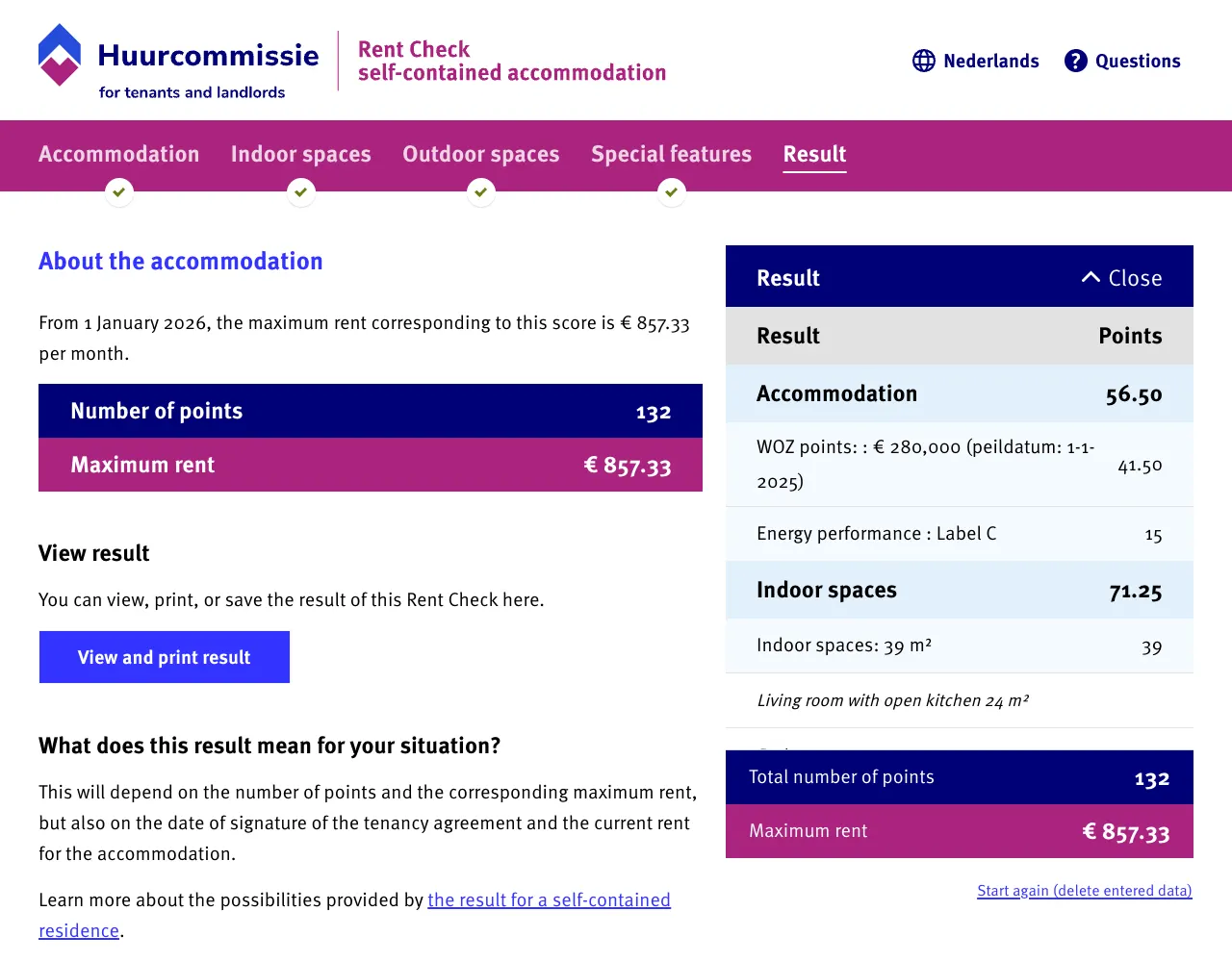
The result screen for our fictional 42 m² flat, period 2026. Screenshot of huurprijscheck.huurcommissie.nl, 10 November 2026.
What do you need before you start the huurprijscheck?
You need five things, all listed by the Huurcommissie. Gather them first, or you will be clicking back and forth:
- WOZ value: free on the WOZ-waardeloket, by postcode and house number. No WOZ yet? A valuation report from a registered appraiser also works.
- Energy label: free on EP-Online, by address. Note the class and when it was issued.
- Floor area of every room, bathroom and kitchen included.
- Length of the kitchen counter.
- Outdoor and storage space: balcony, garden, terrace, bike shed, storage or garage, in m².
Accommodation
Address, time period, WOZ value and its reference date, energy label or year of construction, type of building, shared indoor spaces.
Indoor spaces
Every room with its area, heated or cooled, the kitchen counter and kitchen amenities, the bathroom and its amenities, storage and landing.
Outdoor spaces
Balcony, roof terrace, garden or loggia in m², the number of addresses that share it, parking spaces of at least 12 m².
Special features
Listed building, care home, facilities for disabled persons, new build, video intercom, small new homes around Amsterdam and Utrecht.
Result
Total points and the maximum basic rent for the period you chose. Save it as a PDF and compare it with your kale huur.
The tool has a "Save and continue later?" button. You get a link by email that reopens your data for four weeks, and the Huurcommissie says your email address is not stored. Handy if you still need to measure the bedroom.
Step 1: Accommodation (address, period, WOZ value, energy label)
The first screen sets the basics: address, time period, WOZ value, energy performance, type of building and shared indoor spaces. The two fields that matter most are the period and the WOZ reference date.
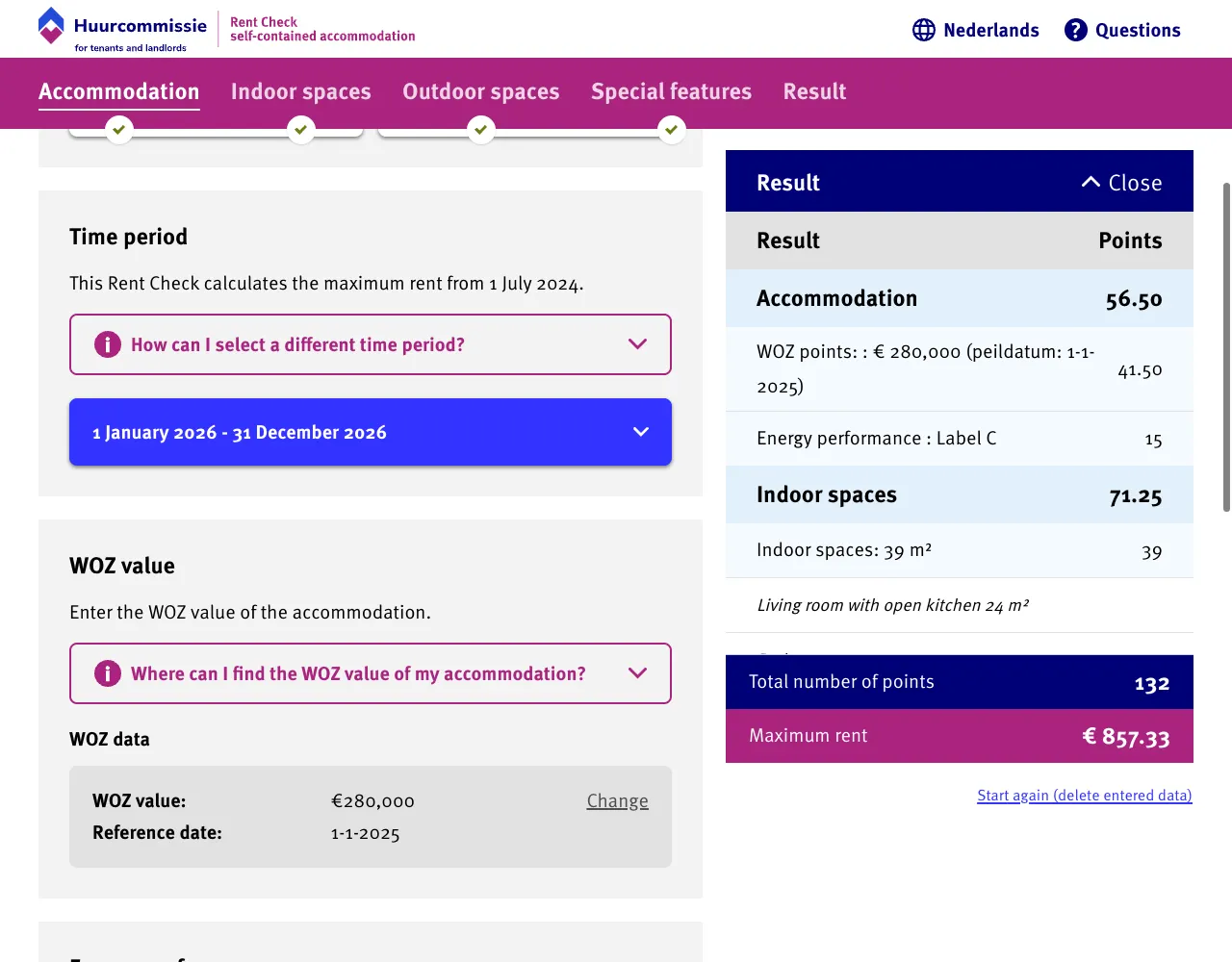
The first screen with our test values. Screenshot of huurprijscheck.huurcommissie.nl, 10 November 2026.
Address. The tool looks your address up in the land registry. If it fails, the help text says to write "H" instead of "high" or "hs", "BS" instead of "bis", and to try both 45-1 and 45/1. The address is optional for the count: our run worked without it.
Time period. On 10 November 2026 the menu offered four periods: the second half of 2024, 2025, 2026 and 2027. Pick the period your rent starts in. A contract starting in January 2027 uses the 2027 period, with its own table. For a period whose legislation is not final yet, the tool shows a preview and says the result may still change.
WOZ value and reference date. Type the value, then pick its reference date (peildatum, the valuation date). The Huurcommissie policy book uses the most recently set WOZ value, and the valuation date is always 1 January of the year before. Its own example: for a contract of 1 August 2026, the WOZ value set for 2026 counts, which has valuation date 1 January 2025. Take that line from the WOZ-waardeloket, not an older one. A wrong year changes the WOZ points.
Energy performance. Click "Change" and choose the type first. The options are "Energy label", "Energy Index (2015-2021)", "Energy label from 2021", "Small accommodation up to 40 m² (2021 to 1 July 2024)" and "Year of construction". EP-Online shows which type you have. Nothing on EP-Online? Then it works from the year of construction. One trap the tool flags itself: for a home of up to 40 m² and a calculation from 2025, the transitional rule has expired. Select "Energy label from 2021" with the same class instead of the small home option.
Type of accommodation. Single-family house (usually a terraced house) or multiple-family building (a flat). The decree gives energy performance different points for each, so don't guess.
Shared indoor spaces. Answer "yes" if you, as the tenant, may use indoor spaces shared with other addresses: a shared bike shed, laundry room or cellar. You fill them in on the next screen.
Step 2: Indoor spaces (rooms, kitchen, bathroom)
Most of the points sit here, and so do most measuring mistakes. You add each space separately: living room, kitchen, living room with open kitchen, bedroom, bathroom, toilet, plus a list of "other indoor spaces" (storage room, attic, landing, cellar and more).
Measure the way the Huurcommissie does. Its policy book measures wall to wall, at 1.50 m above the floor, including built-in cupboards. An L-shaped room? You can add a second length and width field. A chimney breast or bulkhead takes floor space? Add a field with a negative width, the tool's own trick (for example 0.64 by minus 0.32).
Hallway and landing. The policy book gives a hallway no points for its area. In the tool, the "Landing" space only asks whether it is heated. So don't add the hallway's square metres to the living room.
Open kitchen. Pick "Living room with open kitchen", not "Living room" plus nothing. Heated, it earns 4 heating points, because the policy book values the open kitchen separately for heating. In our run that was 2 points more than counting it as one heated room.
Heated and cooled. Each room asks both. A cooling system only counts with at least energy label A+ and a capacity of at least 100 W/m² at up to 35 °C, says the help text.
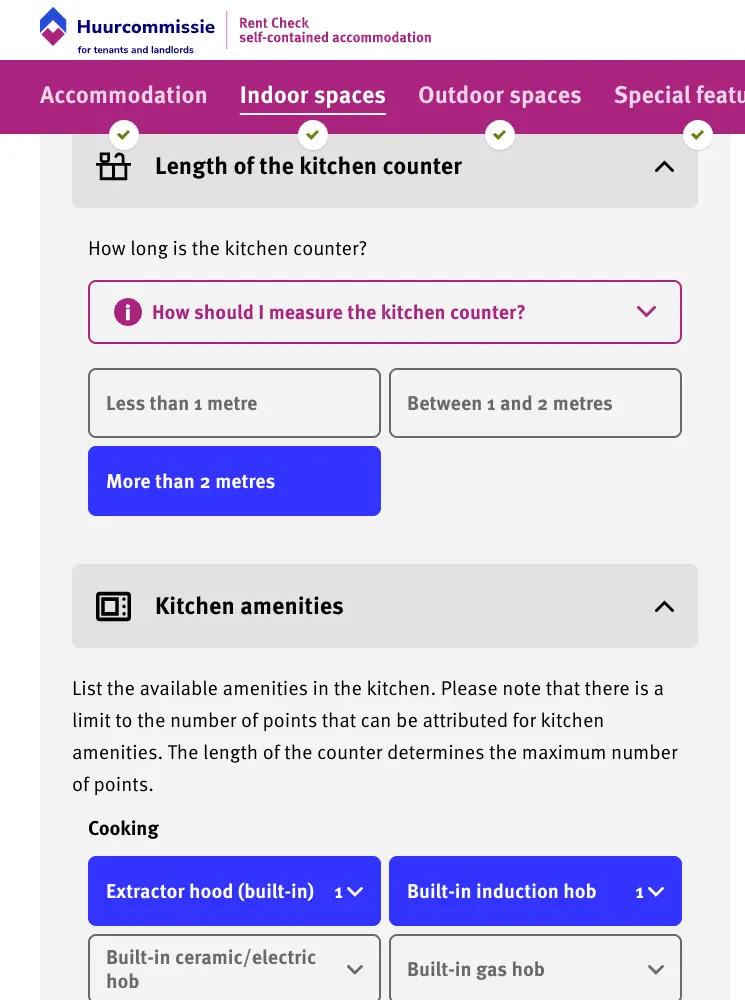
The kitchen part of the indoor spaces screen. Screenshot of huurprijscheck.huurcommissie.nl, 10 November 2026.
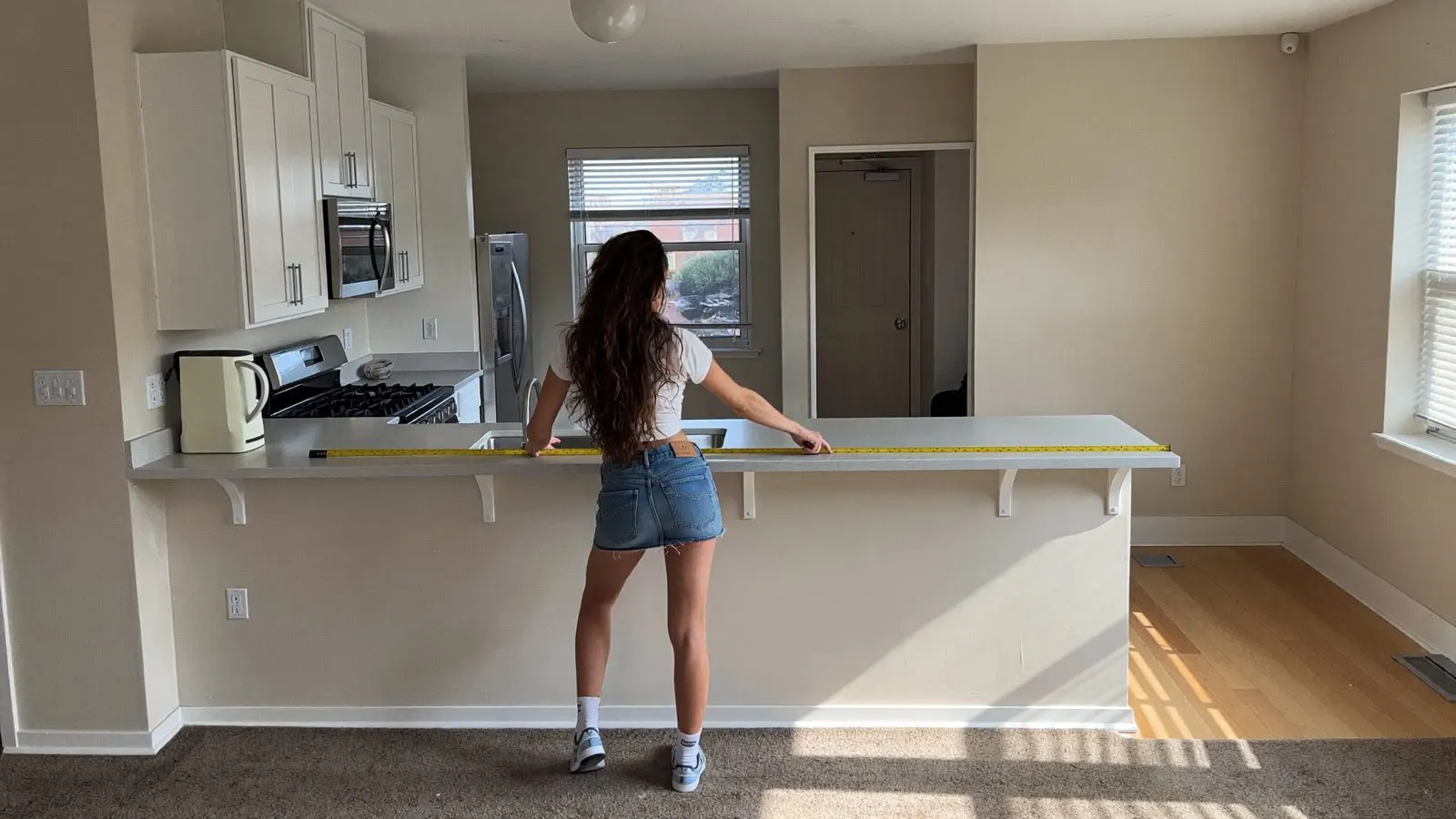
Kitchen counter. Three choices: less than 1 metre, 1 to 2 metres, more than 2 metres. Measure along the centre of the worktop, built-in sink and hob included. The length also caps the points for kitchen amenities, so this field decides a lot. A landlord who lists a 2.2 m counter that measures 1.9 m is giving you the wrong band.
Kitchen amenities. The list covers built-in appliances and taps: extractor hood, hob (induction, ceramic or gas), mixer taps, fridge, freezer, oven, microwave, dishwasher. A combination fridge freezer counts as two items, and so does an oven with a microwave function. Extra cupboards count per 60 cm of width on top of a standard 100 cm cabinet, rounded down (the help text's example: 210 cm makes 3).
AI-generated illustration.
Bathroom. First choose: only a separate shower, a bath, or a bath and a separate shower. Then the amenities: toilet in the bathroom, washbasin, taps, a fully fixed shower screen, sink cabinet, extra cabinet of at least 40 by 40 cm, electrical outlets, towel radiator. The points for extras are capped, and the cap depends on the type of sanitary facilities.
Extra kitchen unit, bath or shower. A washbasin in a bedroom or a kitchenette in the attic goes under "Additional kitchen unit, bath or shower", not in the main kitchen or bathroom.
Step 3: Outdoor spaces (balcony, garden, parking)
This screen covers the outdoor spaces the tenant may use: balcony, roof terrace, front or side yard, backyard, loggia, or "no outdoor spaces". Enter the area in m² for each.
Shared with another address. For a shared garden or courtyard, give the number of addresses that share it, your own included, and not the number of people. One neighbour and you makes two.
Parking space. A parking space counts if it is a marked spot of at least 12 m², big enough for a standard car. A bike rack is not a parking space. A bike shed goes under storage with the indoor spaces.
Step 4: Special features (monuments, new builds, Amsterdam and Utrecht)
These add points or a surcharge on top. Answer all of them. "No" is the default, and a landlord cannot claim a feature the home does not have:
- Listed building: municipal or provincial monument, protected townscape (only homes built before 1965 get extra points), or national monument. For a national monument the answer depends on whether the contract was signed before or from 1 July 2024.
- Care home: a home for people with physical disabilities in a building with shared spaces, barrier-free access and at least a personal alarm. Points go up 35%.
- Facilities for disabled persons: only what the landlord paid for, such as a raised toilet or a stair lift, with the cost.
- New buildings: completed in 2015 to 2019, or first occupied after 1 July 2024 with construction started before 1 January 2028. The new build increase only applies to a total between 143 and 186 points.
- Intercom with video display.
- Amsterdam and Utrecht regions: a home under 40 m² completed in 2018 to 2022 in the listed COROP regions around Amsterdam and Utrecht gets extra points. All three conditions must apply.
Step 5: How do you read the result of the rent check?
The last screen shows two numbers: your total points and the maximum rent for the period you chose. Our test flat: "From 1 January 2026, the maximum rent corresponding to this score is € 857.33 per month." Under "View and print result" you can view, print or save it. Save it, and keep it with your contract.
Then read it against three things, within the rules for your contract:
- The segment. Up to 143 points is sociale huur (social housing, regulated), 144 to 186 points is middenhuur (middle rent, also regulated), 187 or more is vrije sector (free sector), where no legal maximum applies. The 2026 ceilings are €932.93 and €1,228.07.
- Your contract date. Middle rent only exists for contracts signed on or after 1 July 2024. It's the signing date that counts, not the start date.
- Your kale huur. Compare the maximum with the basic rent you pay. Service charges and furniture don't count, so ask your landlord for the split if the contract shows one total.
Don't trust the English result page on dates. On 17 November 2026 the Huurcommissie's English explanation of the result still used older limits (€900.07 and €1,184.82) instead of the 2026 ones and said "on or after 1 July 2025" for middle rent contracts. The Dutch version shows the same older amounts but says 1 July 2024, and so does the law. Go by 1 July 2024 and the 2026 amounts above.
The result is not a binding decision. The Huurcommissie says it plainly: a measuring error or a misunderstood question can change the outcome, and in a case it always does a new points count of its own. Use the check to decide whether to act, not as proof.
Paying more than the maximum? In social and middle rent you can challenge it: ask the Huurcommissie for a rent reduction of your initial rent (aanvangshuur) within 6 months of the contract start. A lower rent then applies from the start of the contract, and you keep paying the agreed rent until the ruling. The full process is in our guide to challenging an unfair rent. Before filing, send your landlord your PDF next to their own points calculation, by email, so there is a paper trail. If the landlord does not adjust the rent, the tribunal takes a decision, and the rent can be reduced back to the first day of the contract.
Frequently asked questions
Is the Huurcommissie rent check available in English?
Yes. The self-contained and shared checks both have an English version, with a "Nederlands" switch at the top. The Besluit huurprijzen woonruimte, the decree behind the points, is only in Dutch.
Is the huurprijscheck free and is the result binding?
It cost us nothing and needed no account (our test, 10 November 2026). The result is not binding: in a case the Huurcommissie does its own points count.
Which WOZ value do I enter in the rent check?
The most recently set value at the start of your rent. For a contract starting in 2026, that is the value with valuation date 1 January 2025, on the WOZ-waardeloket.
What if my home has no energy label?
Choose "Year of construction" under energy performance. The check then works from the building year. Look on EP-Online first, by address.
Can my landlord charge more than the rent check says?
In social and middle rent, no. Under the Wet betaalbare huur (Affordable Rent Act) the maximum is a binding national standard, and since 2025 the gemeente (municipality) can fine a landlord up to €100,000. Above 186 points, in the free sector, there is no maximum. Still, the tool gives an estimate until the Huurcommissie has done its own count.
Can I use the rent check after a rent increase?
Yes. Pick the period in which the increase takes effect. For a proposed increase with an effective date before 1 July 2024, the Huurcommissie points you to the previous version of the tool.
Can I use the rent check for a room?
Yes, but use the shared accommodation check. Rooms with a shared kitchen, toilet or bathroom have their own points system.
Can I already check a contract that starts in 2027?
Yes. On 10 November 2026 the check offered the period 1 January to 31 December 2027. Our test flat, with the same WOZ value, got €881.94 there, the amount in the 2027 table for 132 points. The tool shows a period whose legislation is not final yet as a preview, so treat that result as an indication.
Where do I find homes that are priced closer to their points?
Renthunter.nl brings listings from 1,100+ Dutch rental sites into one search, so you can filter on budget and run the check on the ones you shortlist. A listing rarely gives you the WOZ or the kitchen, so the check stays your job.
Conclusion: measure first, then trust the number
The Huurcommissie rent check is not hard, it's fussy, and it gives a tenant real protection only when the numbers going in are right. Five steps, about a dozen fields, and each one asks for a number you have to look up or measure. Get the WOZ year right, pick the right energy type, measure wall to wall and count the open kitchen properly. Then compare the maximum with your kale huur, not with your total bill. Know your numbers before you pay a euro more than the table allows. Don't just take the number on your contract. Check it, save the PDF and keep the date in mind: you have to act within 6 months.
Next steps:
- Run the check: the Huurcommissie rent check for self-contained homes, with your WOZ value and energy label at hand.
- Understand the points: our guide to WWS points and to energy labels for renters.
- Rent too high? Our steps if your rent is too high and how to challenge it at the Huurcommissie.
- Compare with the market: the fair rent calculator compares your rent with market prices. That's not a points count.
- Keep searching: RentHunter does the searching across 1,100+ rental sites. You do the viewings.
Sources
- Huurcommissie: Rent Check, Rent Check self-contained accommodations, the tool, result page in English and in Dutch, policy book notes, 2026 rent table, Wet betaalbare huur for tenants, starting rent review, checked 10 November 2026; result pages and the tool's notice on periods checked again 17 November 2026
- Staatscourant 2026, 35093: maximum rent limits 2027, checked 10 November 2026
- WOZ-waardeloket and EP-Online, checked 10 November 2026
- RentHunter test of the official rent check with a fictional home, 10 November 2026
- RentHunter data: free-sector studios and apartments first seen 1 January to 31 October 2026, deduplicated, medians
Free alert
Paying more than the rent check maximum? See how to ask the Huurcommissie to lower a starting rent within 6 months of the contract start.


Ready to find your perfect home?
Join thousands of expats, students, and professionals who found their home with RentHunter.